
Bless Their Hearts
"Be civil" is not the prescription for this moment.

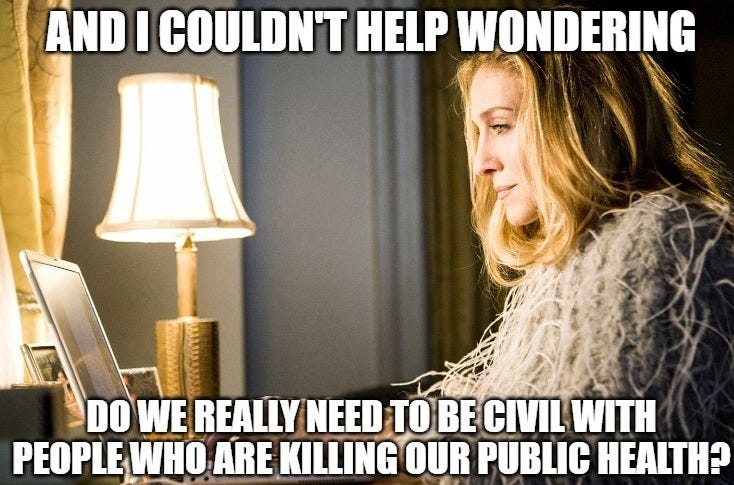
It’s January 6 and whether thinking about geopolitics or public health, it has already felt like a long year.
Following the Trump Administration’s reckless upending of the childhood vaccine schedule to recommend far fewer vaccines, bringing it in line with Denmark (which has a far more robust social safety net and, I might add, a recent whooping cough epidemic), I got into a Facebook tiff with a Stanford professor who shall remain nameless but who came to the defense of Jay Bhattacharya, Vinay Prasad, and Marty Makary.
(Please excuse me while I choke back vomit and then rejoice in having come from a family of Cal bears… obligatory Go Bears.)
Part of the argument they made was about the importance of respectful civic discourse, of which I was initially just dismissive in the current climate, but then it got me thinking.
Do we really need to be civil with those who are killing our public health to an extent that people will most assuredly die from preventable diseases and it will take not just years, but decades to repair?
I think of myself as a good person. I pay my taxes, I’m a supportive friend, I rescue cats, I’m a good professor and take pride in mentoring students (especially those from underrepresented groups), I do charitable giving, and I advocate for inclusive policies and vote for candidates who pledge to lift people up rather than concentrate wealth at the top.
But I’m also of the belief that respect is earned and civility is not the appropriate response to those who are incinerating everything from public health to democracy itself, with the blessing of Chief Justice John Roberts (our very own C.B. Bucknor in robes). And I believe that it is better to be good than to be friendly. (What can I say, New Yorkers are my people.)
Imagine telling the parent of a child who senselessly died from a measles outbreak that they must “be civil” and “respectful” to the anti-vaxxers in their community who contributed to reduced herd immunity, endangering their family. (Or giving “be civil” advice to the parent of a trans child whose mental health declined precipitously when denied gender-affirming care under this Administration.)
Now think about the reality that the people leading our public health bureaucracy – Robet F. Kennedy Jr., Jay Bhattacharya, Vinay Prasad, Marty Makary, and Mehmet Oz – are not rubes listening to their quirky aunt who tells them that vaccines cause autism and whatever you do, don’t take Tylenol when you’re pregnant because she heard something on talk radio.
Perhaps they can’t hear the cries of parents whose children are hospitalized with measles, because their heads are too far up their asses – or more likely, too far up Trump’s ass (an unfortunate affliction). But these are people who know better. They understand what it means for the Wakefield study to have been retracted in spectacular fashion, with Wakefield even losing his medical license. They are capable of comprehending peer-reviewed research and know the difference between correlation and causation. They know exactly what they are doing. And they don’t care about the body count that will accumulate as a direct result of their reckless actions.
Science is iterative and there is uncertainty and there must be grace for good faith efforts to get some things wrong. But these are not good faith actors. This is the rejection of sound science for purely opportunistic reasons at the expense of the public’s health and safety. (See also the actions of Joe Ladapo, who I knew at UCLA and who absolutely knows how wrongheaded and dangerous his actions as Florida Surgeon General are, but who prioritized seizing an opening for power and influence.)
This is not a commentary on how these people behave in their private lives. I have a hard time believing that truly good people would sleep well at night inviting the proliferation of uninsurance and infectious diseases, but setting that aside, at the end of the day, making the choice to enter public life means being judged based on one’s actions rather than their private behavior. It’s a conscious choice to be judged on that basis, and the actions taken defy logic, science, and any semblance of decency.
This does not demand respect and civility. It demands accountability and swift removal from power, and action that demands bipartisan cooperation around issues that should (but I recognize won’t) transcend party lines given that infectious diseases do not discriminate between party identifications.
As you may have guessed from my… well, everything… I’m a Democrat. But I’ve long criticized a number of Democrats for meeting crises and institutional arson with kumbaya vibes. Frankly, I think that’s partly why we’re here now.
Grants have been canceled. We are greatly restricted in what we can research with federal funding. Critical health agencies are being axed or rendered impotent (see AHRQ, HRSA, SAMHSA), which will make it virtually impossible to support health policy predoctoral and postdoctoral training programs. Health insurance programs are being gutted and sabotaged. Vaccine schedule changes are putting people at risk for dangerous infectious disease outbreaks. And they’re not even a full year into the horror they are determined to unleash.
When someone responds to this with “be civil,” remind them what’s at stake, and ask them what they have to gain from defending these reckless and destructive actions.
And as for those running what’s left of our public health bureaucracy, I just have three words: Bless their hearts.
Just say it was JPAI and be done with it.
Thank you for expressing what I feel to my core. It’s of a piece with being told we need to understand Trump supporters (interviews with rubes in rural diners). And now we’re supposed to be civil to those who should know better (actual doctors and scientists).